 Swapx
Swapx concentrated liquidity
SwapX is a decentralized exchange on Sonic with concentrated-liquidity pools that use Algebra Integral. Providers allocate capital within selected price ranges. A position supplies active liquidity while the pool price is inside its range; outside that interval, it becomes inactive and stops generating trading fees.
Updated:
Price Ranges and Pool Activity
Range width changes how tightly a position’s capital is concentrated. A narrower interval covers fewer prices, while a wider interval spreads capital across more prices. Concentration can make more liquidity available around the prices at which trades occur, provided those prices remain within the position’s range.
Pool-wide volume can include trades served by other active positions. An individual provider’s position can remain inactive if the price lies beyond its own boundaries, even while the pool is busy.
SwapX also offers classic pools with a Uniswap-style formula for volatile pairs or a Solidly-style curve for stable pairs. These are distinct pool designs; the selected-range activity rule describes concentrated-liquidity positions.
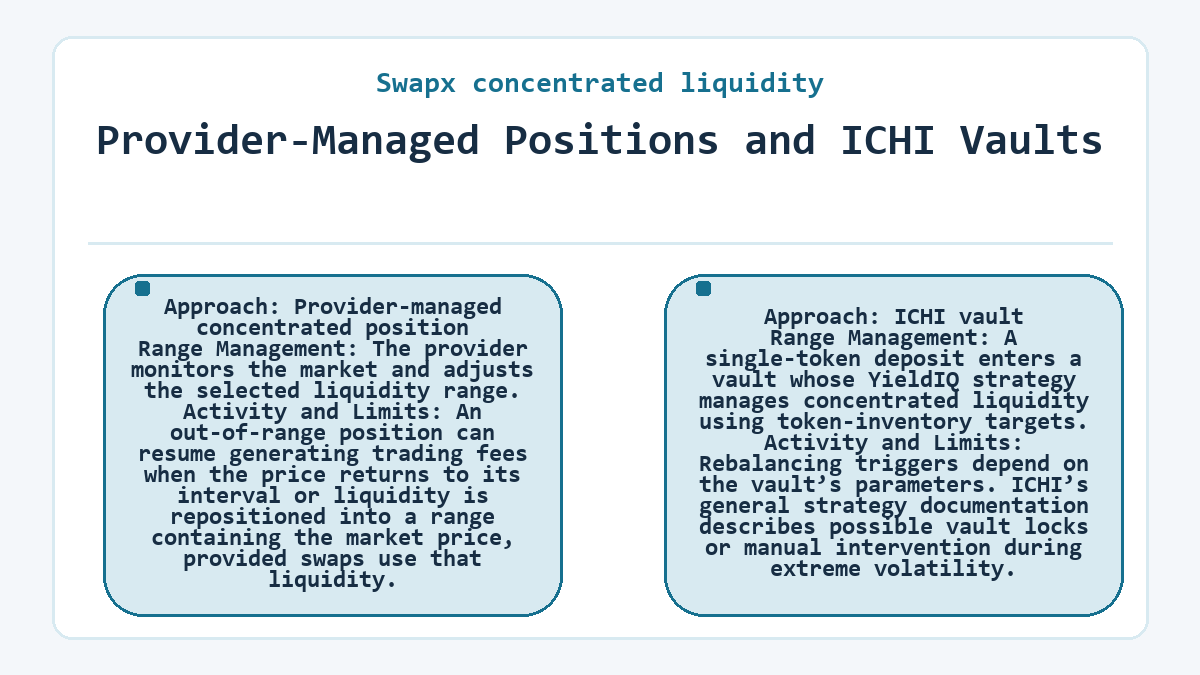
Provider-Managed Positions and ICHI Vaults
| Approach | Range Management | Activity and Limits |
|---|---|---|
| Provider-managed concentrated position | The provider monitors the market and adjusts the selected liquidity range. | An out-of-range position can resume generating trading fees when the price returns to its interval or liquidity is repositioned into a range containing the market price, provided swaps use that liquidity. |
| ICHI vault | A single-token deposit enters a vault whose YieldIQ strategy manages concentrated liquidity using token-inventory targets. | Rebalancing triggers depend on the vault’s parameters. ICHI’s general strategy documentation describes possible vault locks or manual intervention during extreme volatility. |
Trading Fees and SWPx Incentives
Active liquidity can generate fees when swaps use it, while the reward system determines who receives them. SwapX’s ve(3,3) design lets veSWPx voters earn swap-fee rewards and voting incentives.
The YieldIQ Strategy documentation specifies that trading fees are routed to voting gauges in ve(3,3) systems. That condition qualifies its general description of fees compounding into a vault position. Automated management alone therefore does not imply that those fees compound into a SwapX vault depositor’s position.
SWPx liquidity incentives are a separate stream of weekly emissions allocated to pools through voting. SwapX governance can adjust the emission decay rate, so an active range alone does not establish a fixed SWPx reward rate. A position can also lose value through market movements, and rewards may not offset that loss.